

Photo Story
Archive
Change over a lifetime: Witnessing the decline of Armenia’s Lake Sevan
Journalist: Shushan Abrahamyan
Photographer: Artem Mikryukov
Edition:
2023
Topic:
Environment
Archive
The article you are reading is part of the Chai Khana archive. From 2015 to 2025, Chai Khana covered the South Caucasus, sharing stories from Georgia, Armenia, and Azerbaijan.
Rolan Davtyan, 90, points to the white lines on the nearby cliffs as we pass the road that connects the town of Sevan to what is now a peninsula. The lines mark where the lake used to reach years ago. Today, the lake is too far away to imagine it ever reached this height.
Neither the road nor the railroad tracks that connect the town to the peninsula existed there when he was growing up: the area was entirely covered by Sevan Lake. The only way to reach the island was by boat.
A former head of water transport of police, Rolan grew up in Tsamakaberd village, which is now a district of Sevan. Located about 60 km from the capital Yerevan, the town is home to around 18,800 people today.
“Imagine the town of Sevan was a peninsula, there was water from both sides… I remember the place where there was water and on the other side it was the lake… a town on a peninsula: it was very interesting,” Rolan says. “I remember it, I remember it all.”

Over old family photographs taken by Lake Sevan, Rolan explains how the landscape and lake have changed over the 90 years of his life.

Rolan has lived and worked near and with the water for nearly a century. “It was love,” he says, noting that the lake has played a major role in his family for generations. His father was the head of the fishing brigade and today his daughter works to improve the condition of the lake and its environs.
Growing up with a fisherman father, Rolan remembers his father’s fishing brigade, and how they brought in white fish. "We were happy, it was a shiny fish," he says. His father was a famous fisherman–he was awarded the Order of Lenin for going beyond the call of duty. "He was a very disciplined man, and kept employees in line," says Rolan, recalling that during WWII, women worked instead of men, who were away fighting, and used to refer to his dad as “the boss.”
He recalls swimming in the lake as a child: first on the side where the lake is now, and later, as he grew older, on the other side, which was deeper and thus more dangerous. That side is now dry, full of residential buildings, whole new lives built where the water used to be.

Rolan Davtyan’s father’s brigade before a fishing expedition. His father was a famous fisherman–he was awarded the Order of Lenin for going beyond the call of duty. "He was a very disciplined man, and kept employees in line," says Rolan, recalling that during WWII, women worked instead of men, who were away fighting, and used to refer to his dad as “the boss.”
The level of water began to drop rapidly in 1933, when water from the lake was released as part of a Soviet project to create electricity, explains Evelina Ghukasyan, the head of the Institute of Hydroecology and Ichthyology.
“As the Soviet Union was just forming, Soviet Armenia needed both energy reserves and free lands… In short, it was decided that if they lowered the level of Sevan, they would use the freed lands for agricultural purposes and the water to get electricity,” she says. “In fact, after a few years, they realized that they had made a very serious ecological mistake because they had not considered the consequences of the drop in the water level.”
Evelina Ghukasyan believes the changes in the water levels are the most important factor in the aging of lakes, and the changes it produces can lead to the ecosystem turning to swampland. In this case, it may one day result in the loss of Sevan as a whole.
As it decreases, the sludge at the bottom of the lake begins to circulate with the rest of the water, enriching the lake with biogenic elements which create the perfect conditions for algae, she says. The rapid growth of algae, which is commonly known as the blossoming of the lake, inevitably harms the quality of the water as well.
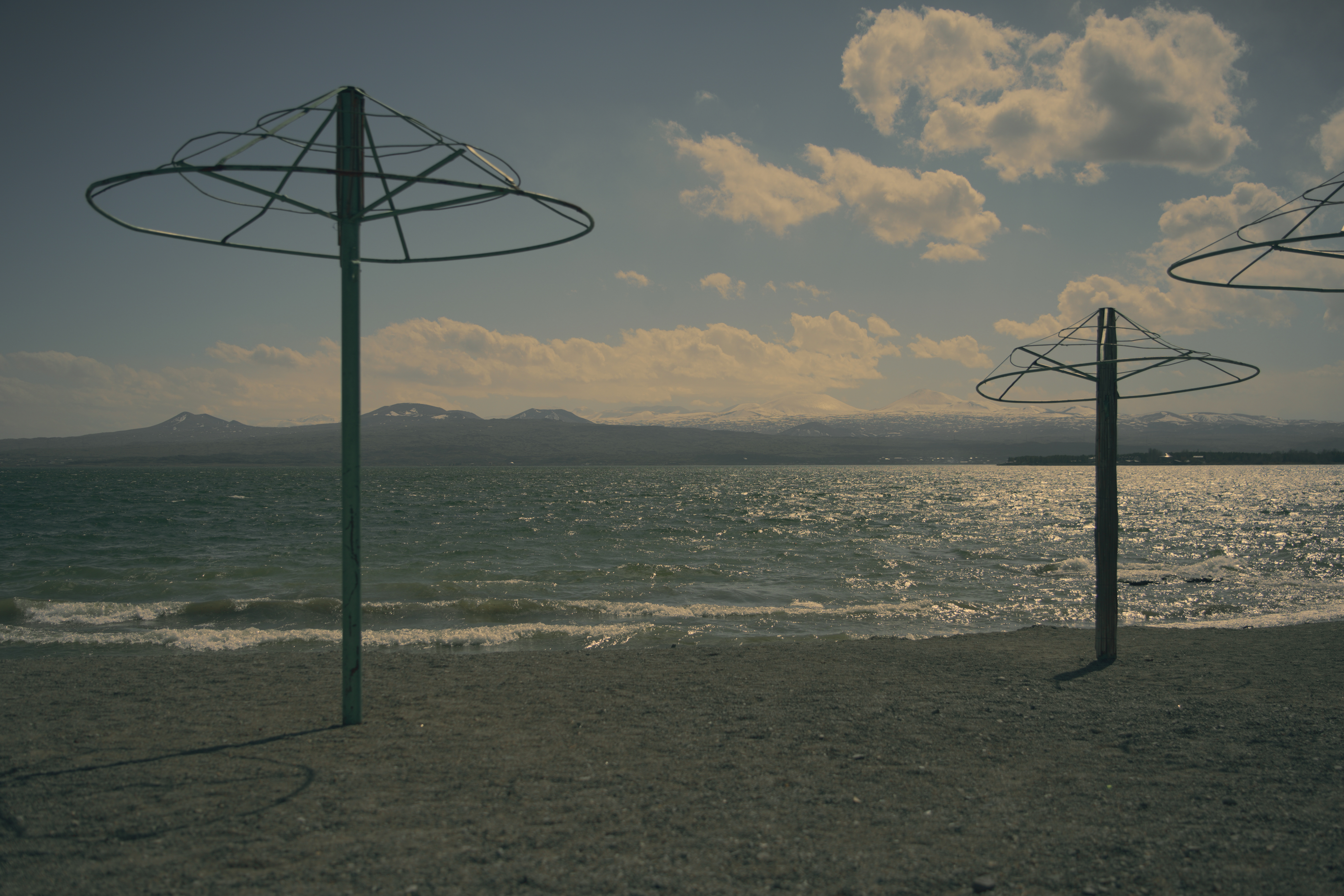
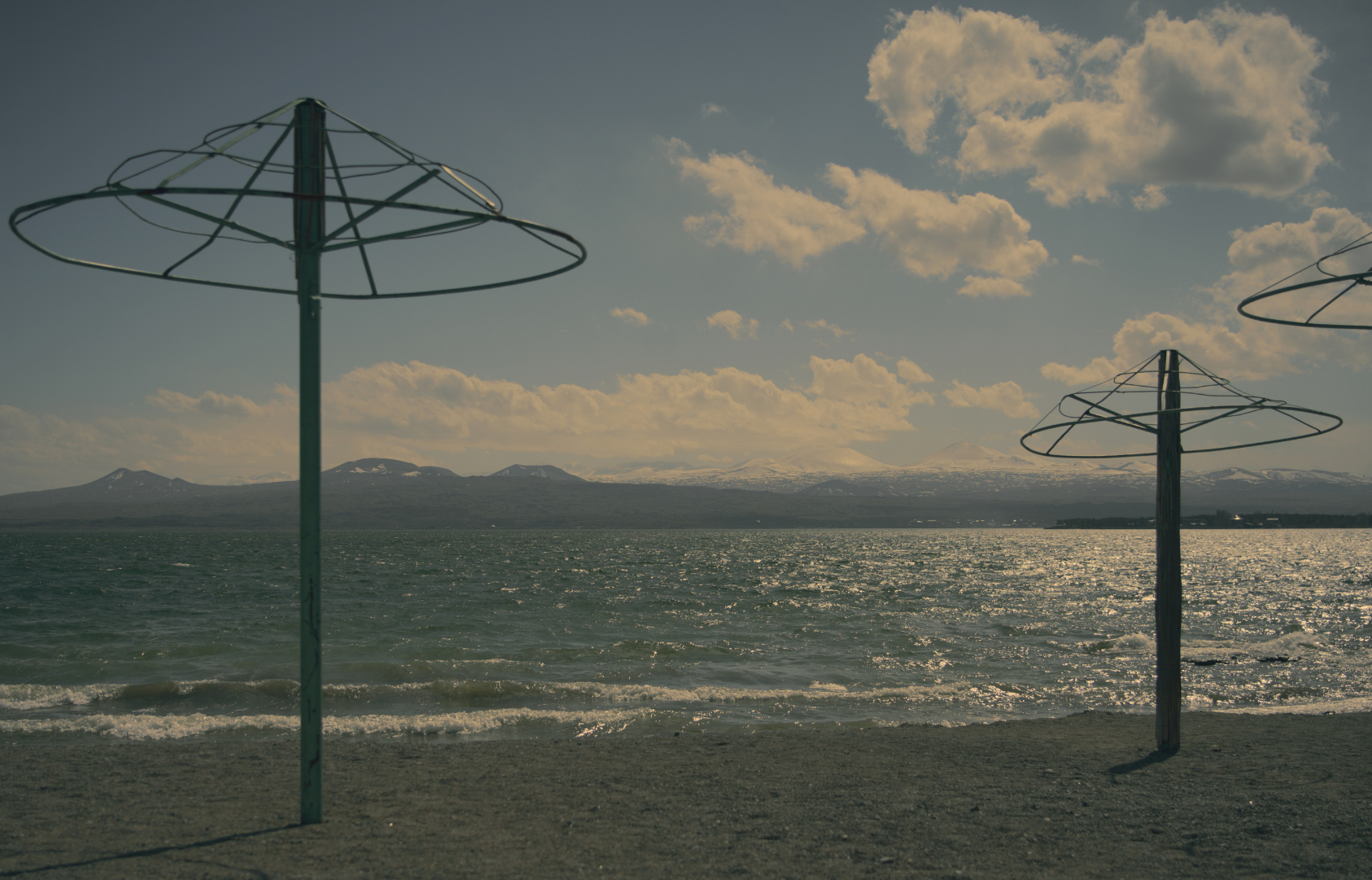
Lake Sevan, March 2023
Rolan first noticed the change when he returned from the army in the mid-1950s. During the three years he had been away, the change was obvious, he says with regret.
“I have lived and grown up with the level of the water… I feel very sorry for it: new people haven’t seen it, they don’t know that it all happened and dried up in front of my eyes,” he says. “It affects me strongly.”
Arev Papazian, a social anthropologist and PhD student at Central European University, is researching the lake. She says the change in the water level is a loss for the locals.
"It seems that water, the connection with water, is important on the level of speech...as it's not seen in everyday life and as it is no longer as present, the relationship has turned into words,” she says. “Everyone says: ‘Oh, Sevan water, Sevan water, Sevan Sevan... Sevan saved the whole country in the 1990s. Sevan's water is drinkable and clean, you can drink it with a glass, when in fact it is not like that at all: It is so polluted that you cannot drink it, but they still say that.”
Rolan remembers the day he drove to the peninsula for the first time on the newly-built road on May 1, 1952. He remembers celebrating the new road, which was supposed to be a good thing, a new way to reach the former island instead of depending on boats. “We didn’t understand [the implications],” he notes.
Anahit Avetisyan, 72, a teacher of Armenian language and literature, grew up in the town of Sevan. Fifty or sixty years ago, locals used to go to the peninsula for cultural events, she recalls. As the winds became calmer and the weather milder, in June or July at the latest everyone would gather there for the “opening” of the season, she says. They had traditional events, festivals, and exhibitions.
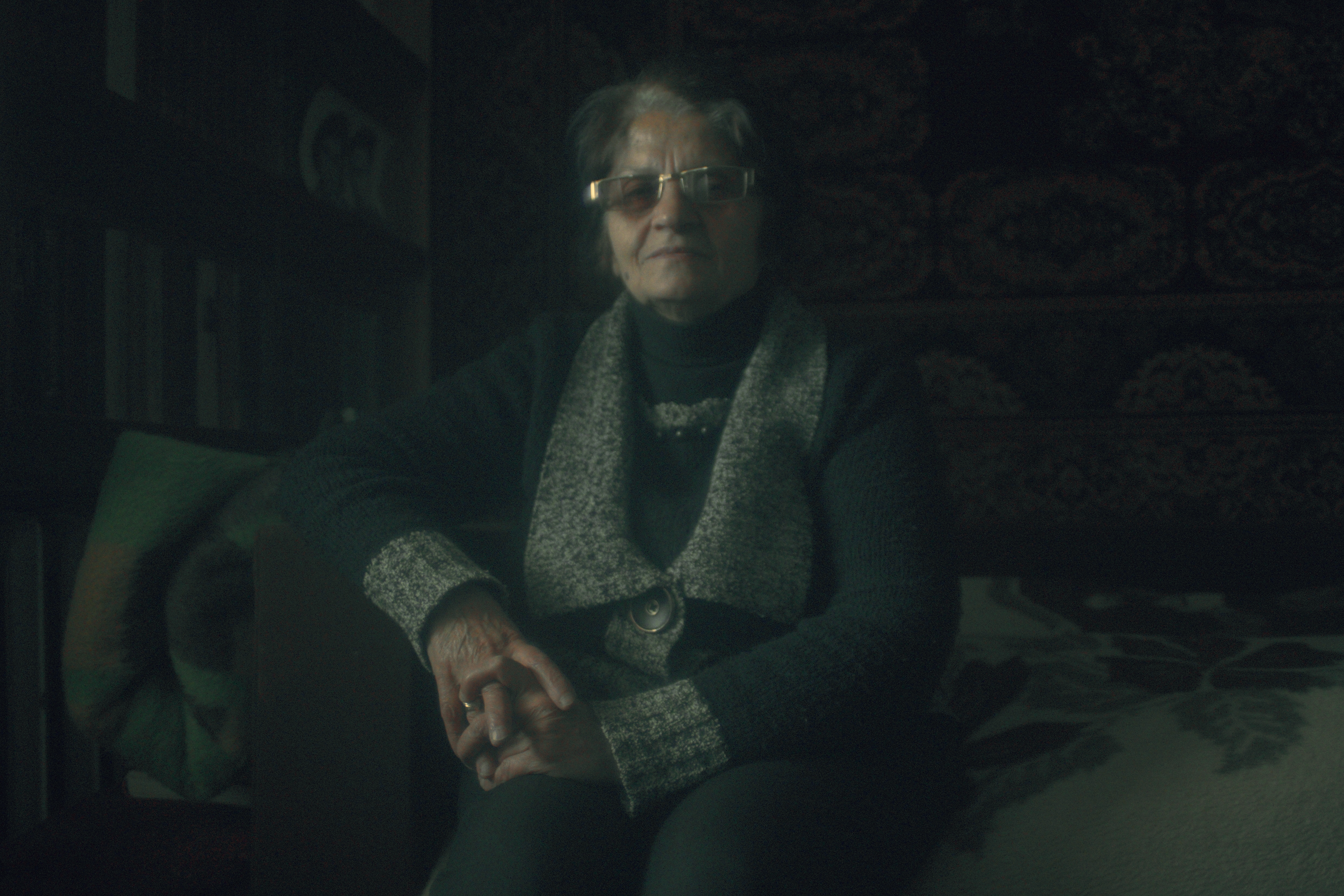
Anahit Avetisyan at her apartment in the town of Sevan, where she grew up and chose to spend her entire life.
“For instance, we started an official marriage ceremony, several couples came and the next year the same couples came to the event together, carrying their firstborn,” Anahit remembers.
The proximity of the peninsula to the town made the latter more active and busy, and later even more touristic, says social anthropologist Arev Papazian. Being so close to the peninsula, the people of Sevan witnessed the transformation of the island into a peninsula.
"As a result of the concentration of various processes, there is a strong memory in the town of Sevan regarding the ecological and historical transformations of the lake" she says.
When in 1964 the lake began to bloom with blue-green algae for the first time, it was a clear warning sign that measures needed to be taken to ensure the water levels increase, according to Evelina Ghukasyan. In the spring of 1981, the Arpa-Sevan Water Complex was commissioned to fill the lake with river water.
Rolan recalls how the Arpa-Sevan Water Complex came to pass. He says the project was first presented to Nikita Khrushchev when he was the first secretary of the Communist Party and visiting Sevan.
"Khrushchev came to Sevan... He ate and drank the 50-year-old cognac, and that was when the ready-made project was put in front of him. ‘Look at this,’ they said, ‘Sign it now... Can this beauty be drained?’"
Anahit Avetisyan remembers when the complex was built as a time of excitement, noting that when she was a child, people even drank filtered water from the lake—something few imagine doing today.
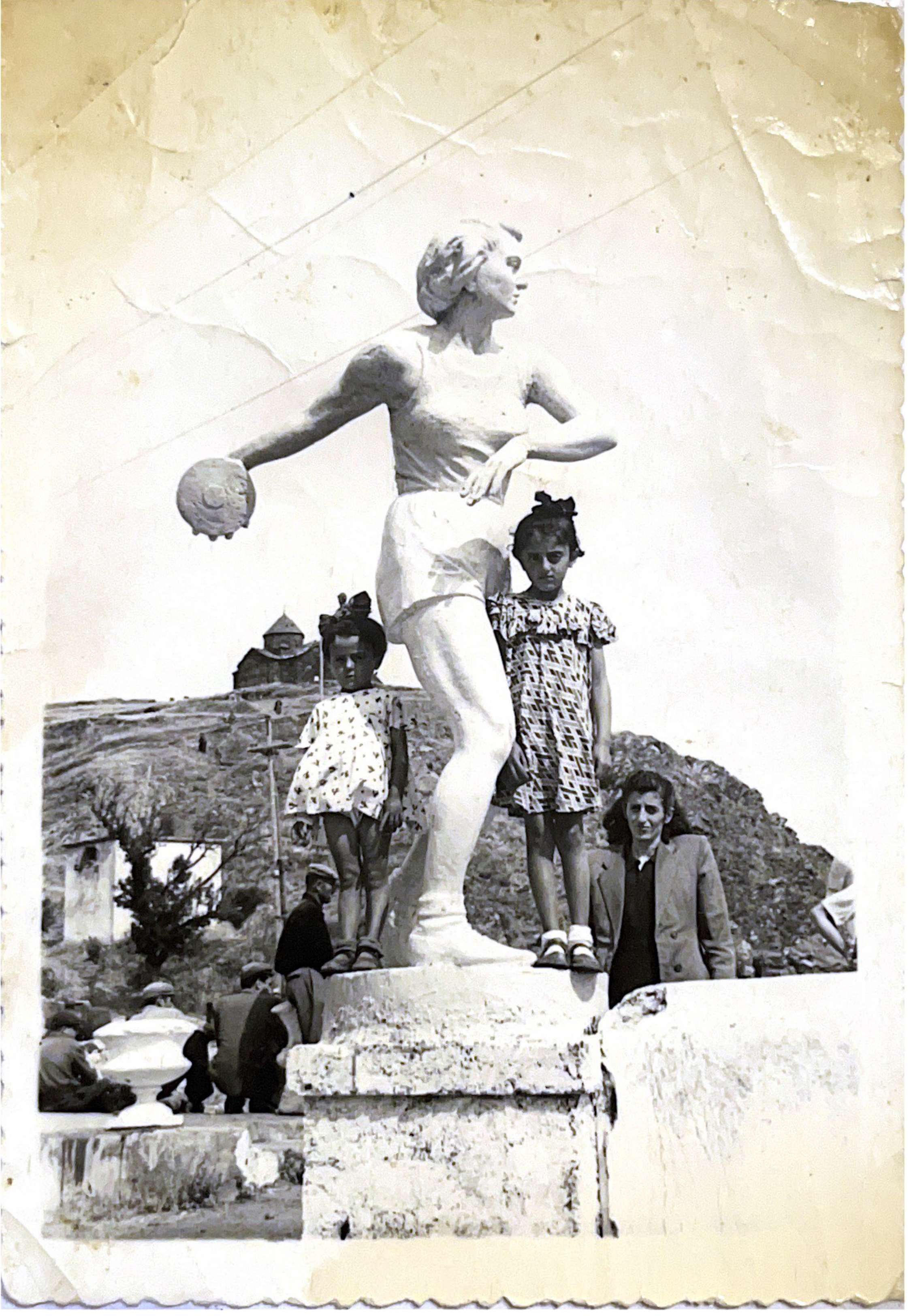
Anahit (aged six or seven), her older sister and her mother.

Her father and his friend posing near the peninsula.
However, even with the complex and the law, the water level continues to drop yearly.
Evelina Ghukasyan explains that for Sevan Lake, the natural fluctuations in the ecosystem have been disrupted. Now, the most important thing is to make sure the water’s condition does not worsen.
While increasing the water level is expensive, she maintains that it should at least remain stable. She notes that in recent years, her institute helped develop a new law that prohibits a negative water weight balance, meaning the lake can rise, but it’s not allowed to get any lower.
Living as close to the lake as Rolan Davtyan and Anahit Avetisyan do, they have never questioned their connection to the lake, nor the way their lives are intertwined with the transformations of the water.
Describing the road next to her house leading directly to the highway and the public beach, Anahit Avetisyan says the daily walk to the shore, no matter the weather, is a tradition for her and other Sevantsis [locals of Sevan]. She shows the photos with her classmates and family members, the photos from her childhood and youth, all in the background of the ever-changing Sevan, a lake, which is described as “the sea”, a lake the shore of which she still visits almost daily after all these years.
Rolan still hopes that the water levels will return to their former heights and "the island will become an island again”. Yet he remains wistful.
“How can I not feel regret? Imagine the cliffs and water crashing into them… It was a huge sea.”
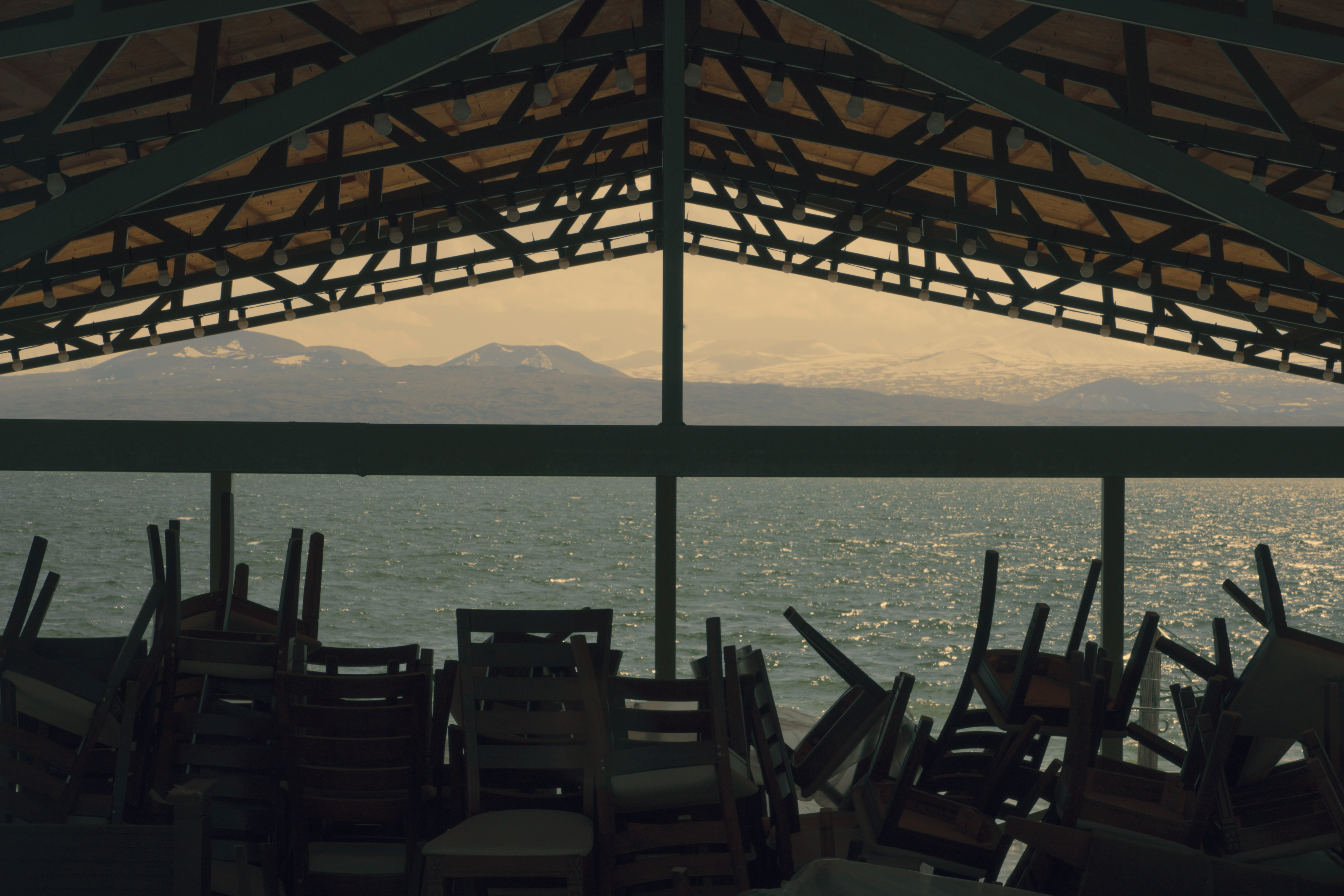
Lake Sevan, March 2023
This feature story was prepared with support from the Friedrich-Ebert-Stiftung (FES) South Caucasus Regional Office. All opinions expressed do not necessarily reflect the views of FES.