

Feature Story
Archive
When work is not enough: Poverty in Georgia
Journalist: Elene Burchuladze
Illustrator: Elene Kavtaradze
Edition:
2023
Topic:
Social issues
Archive
The article you are reading is part of the Chai Khana archive. From 2015 to 2025, Chai Khana covered the South Caucasus, sharing stories from Georgia, Armenia, and Azerbaijan.
For the past thirty years, Nana* has traveled an hour and a half to get to work every day. She leaves her house when it is still dark, and arrives back home long after sunset.
Her three hour total commute, and hours on the job at National Center for Disease Control and Public Health distributing vaccines in the Georgian capital Tbilisi, earn her a grand total of ₾500 (roughly $190) a month—far below the average income of ₾1716 a month.
“I am both physically and mentally exhausted,” she says. But retirement is out of the question for the septuagenarian.
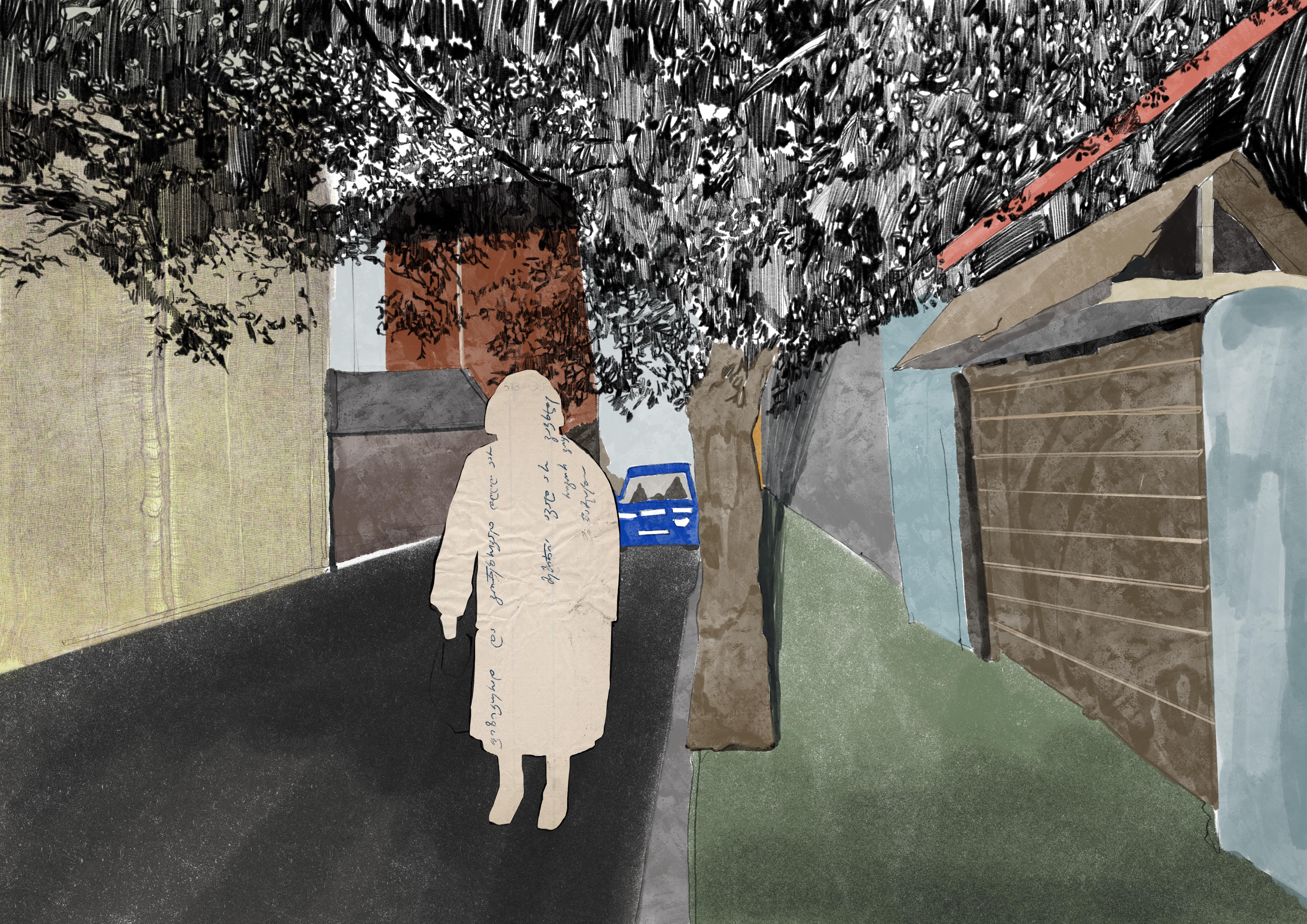
“I wish my income was sufficient for savings, so I could worry less about potential health problems,” she says. “The lack of money makes me afraid for my well-being.”
Nana is part of the estimated 17.5 percent of the Georgian population that lives in poverty. Despite Georgia’s rapid economic growth over the past two decades, an alarming number of its citizens have not benefited.
Sociologist Nino Kheladze found that the Gini index is 40 percent in Georgia, indicating high income inequality, the highest figure in the South Caucasus region. In May, Economy Minister Levan Davitashvili put the Gini index at 36 percent, an improvement from last year, but he underscored the need to lower it further.
Kheladze says that Georgia’s tax policy and lack of a minimum wage are two factors that account for the high number.
Researcher Giorgi Tsintsadze agrees.
“Labor legislation was eliminated back in the 1990s and the Rose Revolution with its extreme neoliberal regulations escalated the situation, abolishing labor inspection, rights to collective disputes and, most importantly, imposing a symbolic minimum wage of 20 GEL which has not changed since,” he says. “That is the cornerstone of economic challenges.”
He adds that while reform was planned for 2019-2022, it never happened.
“A minimum wage is the most fundamental principle for ensuring economic equality, the world has agreed on it and here years go by without imposing it for no tangible reason,” he says.
Nana has been a paramedic since 1969 and has been working her current job since 1993, distributing vaccines.
“The working day begins with me receiving boxes of vaccines, dozens of boxes. I receive them, take the journal and start writing the data down,” she says. “I take out about 100 doses and distribute them. Each day I get around 10 invoices. Each invoice comprises eight brands, in sum at least 80 vaccines a day. I should be careful, these vaccines are for children. My brain works like a powerhouse.”
But the work—and the level of effort required for her to get to her job—are taking their toll.
“My office is very far from here…My right leg hurts - walking hurts and sitting on a bus hurts too. Transportation tortures me and these past months pain has gotten worse. My co-worker saw me the other day trying to walk up the stairs and crossed herself, maybe even said a prayer,” she says.
Nana, her daughter Nino, and granddaughter Elene are all employed—fully engaged in labor. But their work, which runs through their lives like a never-ending river, falls short of providing them what they need. Their struggles illustrate how difficult it can be for a family in Georgia to find a way out of poverty–even if all the adults are working full time. The fate of these three women reflects the reality of many households in Georgia.

Nino, 51, works two jobs at a local kindergarten as a cook and cleaner, for ₾400 a month. The money never lasts more than two weeks.
“The second I get the payment, most of it goes to paying off multiple debts… half of my salary. What worries me is if the salaries stay the same. It becomes gradually more and more impossible to survive on such a low income,” she says.
“My income is so low that I am always grappling with severe financial difficulties. Trying to manage to pay the bills, electricity, gas; all these details put me into an existential tailspin.”
The Georgian economy has been hit hard by inflation since the 2020 pandemic. Even basic food staples have been affected: for instance, since the beginning of 2023, bread prices have gone up around 23 percent.
“I am constantly forced to buy the cheapest products,” Nino explains. “It feels like considering discounted market prices runs in my blood; this is how I relatively get by-- waiting for sales to purchase groceries.” Her limited purchasing power makes it difficult for the family to afford meat.
A life of scrimping to survive has already impacted Elene, 25, the youngest in the family. She is currently working in marketing and her income is not stable. She says she feels constant stress and fear about money and her lack of savings.
“In my childhood, there was an extended period of 2-3 years when paying the bills was a constant and extreme difficulty,” she recalls. “I remember feeling weak and I also remember thinking: why does our family have to worry about paying the bills? Why is it so challenging for us when it is not the case for some other families around me? I would say I am definitely traumatized from my early years and maybe subconsciously always push myself not to become that vulnerable again.”
Gender researcher Giga Karapetiani believes that the concept of savings should be related to improving one’s quality of life and that in Georgia, utterly small amounts are considered savings.
“For instance, ₾1000 is not savings, it might be the cost of one medication,” he says. “Trying to survive is what is meant when savings are touched upon in Georgia and this money is usually collected at the cost of the needs that under no circumstances should be compromised, like the quality of food they consume. Calling such small amounts of money savings implies that the requirements are as minimal as possible and basic needs like healthcare, food and transportation become luxury items.”
For Elene, savings is a priority, even if it means doing without.
“Savings are necessary - knowing that if I do not have a job anymore, I have something to fall back on,” Elene says. “Although, I always struggle to save.”
She notes that the week before payday is always extremely difficult.
“I say no to potentially good times, no to opportunities that are presented to me as a young person. I limit my mobility, I have to reject comfort. If my friends go out, there are occasions when I am forced to stay home: it is dangerous to return home late since I cannot afford a taxi and public transportation does not operate that late,” she says. “ So, I stay home. I believe life is to be experienced and these challenges rob me of events to experience and moments to remember.”

Nana, her grandmother, also worries about savings. “If I am ever in need of surgery, my finances will not suffice,” she says.
The idea of savings differs from generation to generation, notes political economist Lela Rekhviashvili. “The amount of money offered by the government [for retirement] is far from sufficient. It is impossible to make ends meet with just a pension. Therefore, they work,” she says.
Nana says she lives in constant worry that she will lose her job due to her age.
“My age worries me,” she says. “Once my co-worker blamed her mistake on me. Due to my old age, I believe…I can do my job well but my boss constantly urges my assistant to pay close attention to how I fulfill tasks. I think he fears that I do not have a long time to live and that someone will need to replace me.”
For now, however, she is focused on working, making the most out of the salary she has—and trying to help her daughter and granddaughter as much as she can.
“[I wish] not to be hungry or thirsty,” she says. “Beyond that, all my hopes are concentrated on the prosperity of my children. If they are well-employed and this country prospers, I am all set.”
Disclaimer: Chai Khana is using a different name due to security concerns with the protagonist.
The article was prepared with support from the Friedrich-Ebert-Stiftung (FES) South Caucasus Regional Office. All opinions expressed do not necessarily reflect the views of FES.